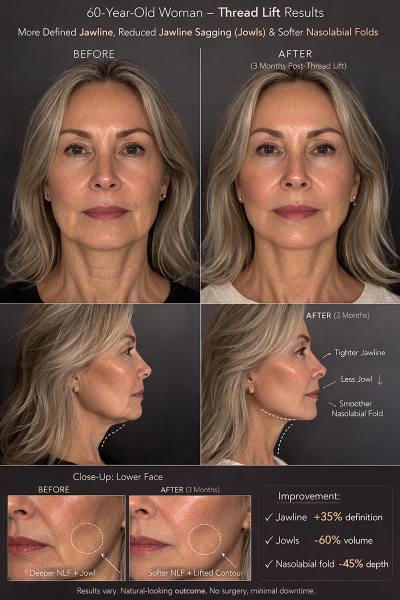
Thread Lift Case Study (60-year-old woman)
Timeline: Before vs After (3 months post-thread lift)
Patient profile
- Age/Sex: 60-year-old female
- Primary concerns: Lower-face heaviness, jowling, softer/blurred jawline, and nasolabial fold prominence
- Goal: Natural-looking lift and contour improvement without surgery and with minimal downtime
Pre-treatment assessment (Before)
- Mild–moderate jawline laxity with visible jowls
- Noticeable nasolabial fold depth, especially with lower-face descent
- Skin quality otherwise healthy, supporting candidacy for thread-based support and collagen response
Treatment plan
- Procedure: Minimally invasive thread lift focused on lower face/jawline support
- Technique (general): Vector lift to elevate descended tissue and reinforce contour
- Anesthesia: Typically local anesthetic (clinic protocol varies)
- Downtime: Usually mild swelling/tenderness; possible bruising for several days
Results (After – 3 months)
- Tighter jawline with improved contour definition
- Reduced jowl prominence on profile view
- Softer nasolabial folds consistent with mild mid/lower-face elevation
Improvement (as shown in the image)
- Jawline: +35% definition
- Jowls: −60% volume
- Nasolabial fold: −45% depth
Note: These percentages are displayed in the case image and can vary by anatomy, thread type, technique, and baseline laxity.
Clinical takeaway
Thread lifts typically perform best for early–moderate laxity driven by tissue descent. In this case, the most visible change is along the jawline/jowl transition, improving contour while preserving a natural look.
Important notes & limitations
- Results depend on baseline laxity, skin thickness, and vector placement.
- Nasolabial folds may improve indirectly; deeper folds may need adjunct treatments.
- Potential risks include bruising, swelling, asymmetry, puckering/dimpling, thread visibility, or infection.